

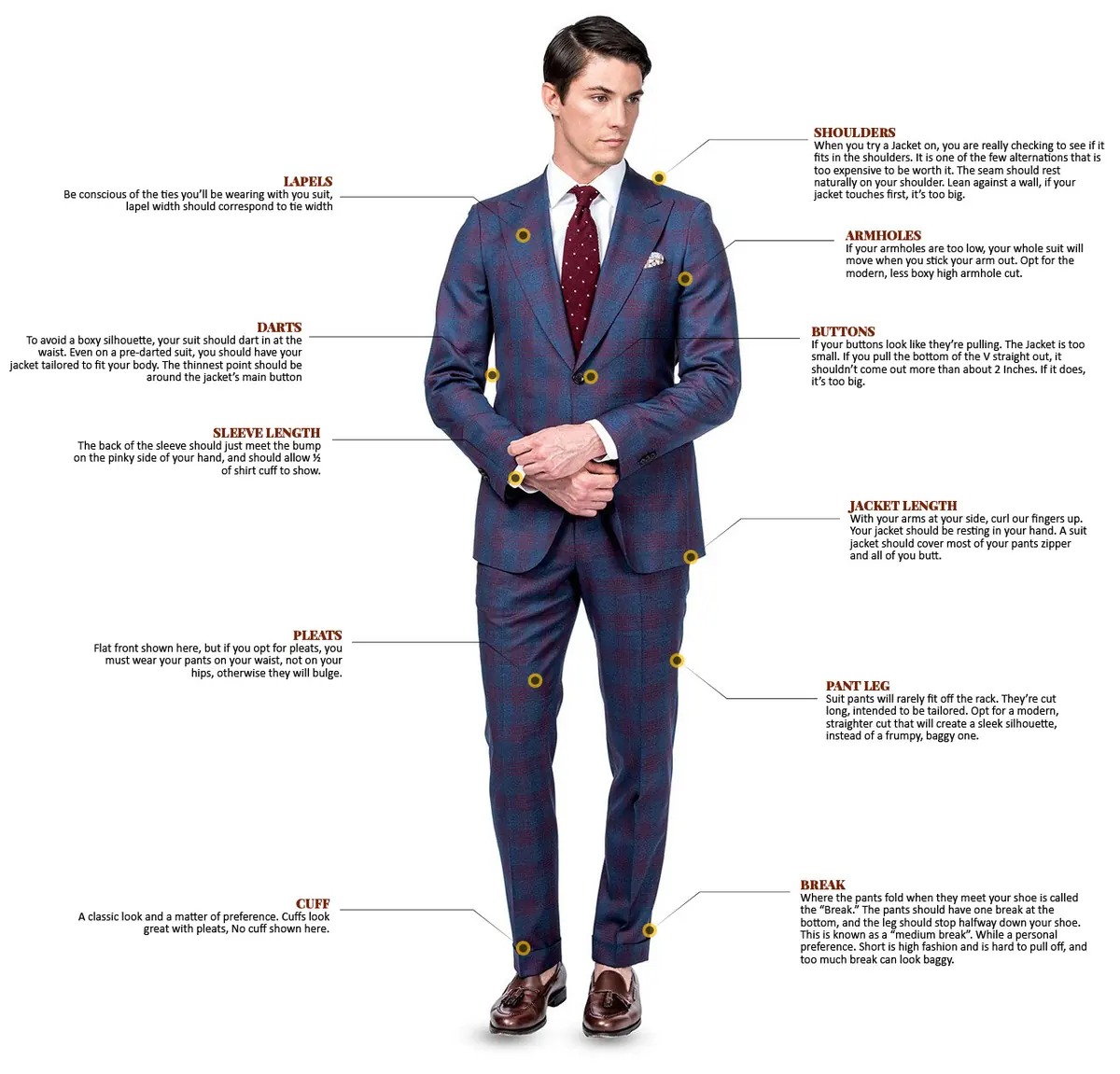
Shoulders: The Foundation of Every Great Suit
The shoulder is the single most important element of suit fit — and the one area that cannot be corrected through alterations. The shoulder seam should sit precisely at your acromion bone, where the shoulder meets the arm. If the seam drops past this point, the jacket will look borrowed. If it falls short, the fabric will pull and restrict movement.
When you stand naturally, the shoulder line should create a clean, smooth silhouette with no rumpling or dimpling where the sleeve meets the shoulder. This is exactly why bespoke tailoring matters — a custom-cut shoulder is drafted to your exact frame, something no off-the-rack suit can achieve.
Chest and Torso: The Two-Finger Rule
Button your jacket at the top button and slide your hand flat between the lapel and your chest. You should be able to fit roughly two fingers — about an inch to an inch and a half of space. This allows comfortable movement without excess fabric billowing at the sides.
Watch for the telltale “X” crease — diagonal pull lines radiating from the button. This signals the jacket is too tight across the midsection. Conversely, if the fabric hangs away from your torso like a curtain, the jacket is too large. A well-fitted chest drapes smoothly against your body, following your natural contours without clinging or gaping.
Jacket Length: The Knuckle Test
Stand with your arms relaxed at your sides. The bottom of your jacket should reach your knuckles and fully cover your seat. Another classic test: you should be able to curl your fingers under the jacket hem comfortably.
A jacket that is too short looks dated and draws attention to the hips. A jacket that is too long appears heavy and borrowed. For shorter men, a slightly cropped length can create the illusion of longer legs. For taller frames, a marginally longer cut maintains proportion. At Manhattan Tailors, our master cutters adjust jacket length to within half an inch to suit your build.
Sleeves: Show Your Shirt Cuffs
Your jacket sleeves should reveal approximately a quarter to half inch of shirt cuff — just enough to show a sliver of white (or whatever colour your shirt may be). This detail is one of the hallmarks of a well-dressed man.
Sleeve length is one of the easiest and least expensive alterations on a jacket, yet it is remarkable how many men walk around in suits where the sleeves completely swallow their shirt cuffs. In a bespoke suit, sleeve length is set precisely during your fitting, so this is never an afterthought.
Collar and Lapels: Clean Lines at the Neck
The jacket collar should sit snugly against the back of your shirt collar with no visible gap. If you can see a strip of shirt fabric between your jacket collar and your neck, the collar is standing away — a sign of poor fit or incorrect posture adjustment.
Lapels should lie perfectly flat against the chest. If they bow outward or buckle, the chest is either too tight or the lapel roll has been incorrectly pressed. In bespoke tailoring, the lapel is hand-shaped to your chest — a process called pad stitching — which is why a handmade lapel drapes differently from a machine-fused one.
The Back Panel: Smooth, Not Stretched
Turn around and check the back of your jacket in a mirror. The fabric should drape cleanly without horizontal creases (too tight) or vertical folds of excess fabric (too loose). If your jacket has vents — whether single or double — they should hang closed when you stand still. Vents that splay open indicate the jacket is too tight through the hips.
A bespoke jacket is cut with your specific posture in mind. Whether you have a forward-leaning stance, square shoulders, or a slight stoop, the back panel is adjusted so the fabric falls naturally on your body, not a generic mannequin.
Trouser Fit: Waist, Thigh, and Break
Your suit trousers should sit comfortably at your natural waist — typically just above the hip bone. You should be able to pinch about an inch of fabric at the thigh, confirming there is enough room for movement without excess bulk.
The trouser break — where the trouser hem meets the shoe — is largely a matter of personal style:
No Break
The trouser just touches the top of the shoe with no fold. Clean and modern — popular for slim-cut and business suits.
Half Break
A slight fold where the fabric rests on the shoe. The most versatile choice, suitable for both formal and business settings.
Full Break
A pronounced fold that pools slightly at the ankle. More traditional, often seen in classic British and Italian tailoring.
At Manhattan Tailors, we discuss your preferred break during every fitting. Hemming is the simplest alteration, yet it makes the difference between a suit that looks considered and one that looks careless.